The Amazon Selling Partner API (SP-API) is Amazon’s REST-based API, built with a level of security and data privacy the old MWS APIs never had — and since Amazon fully retired MWS, it’s the only door into your Seller order data. This guide covers what changed, what building your own SP-API application really takes, and the fast path: connecting through InfiPlex’s approved SP-API app in 1–2 business days. First published during the 2022 migration window; maintained for the post-MWS era.
MWS Is RetiredSP-API is the only door to Seller order data
4 Steps Became 13What a Get Orders call now takes to build
Live in 1–2 Business DaysThrough the approved InfiPlex SP-API app
What changed
From MWS to SP-API: why the door got smaller
The old MWS APIs offered quick access to anyone with an Amazon Seller account. SP-API is different by design: a significantly higher security threshold and an application-configuration requirement for order management make it harder to build your own applications — and give Amazon full control over who can actually make calls to its APIs.
The migration was mandatory. Third-party providers had to convert by July 31, 2022, with individual companies’ own MWS integrations following after — and Amazon has since fully retired MWS. If an MWS order or inventory integration is still sitting in your codebase, it isn’t a migration project anymore; it’s an outage. As an Amazon Seller, that leaves two options: build your own SP-API application, or connect through an existing third-party application — both covered below, and the SP-API inquiry form is the shortcut to a human.
Option one
Build your own SP-API application
Building your own application requires a fair amount of programming time and Amazon AWS expertise. The Selling Partner API Developer Guide has the full requirements; as a basic overview, here’s what it takes:
Pass the SP-API application review process with Amazon’s review team
If you had an existing MWS application, nearly all of the code needed rebuilding. The one exception is the final processing of feed data, where the format is mostly unchanged — but every feed request and response still had to be rewritten, the new authentication process is tied to IAM policies in AWS, and the Restricted Data Token simply didn’t exist in MWS. Amazon’s MWS-to-SP-API mapping reference shows the scale of it, call by call.
The flow comparison
What one “Get Orders” call became
The clearest way to see the difference is a single order retrieval, side by side. Four steps became thirteen — token lifecycles, STS sessions, and a Restricted Data Token just to read the buyer’s name and address.
Old: MWS Get Orders flow
Retrieve stored auth tokens
Generate API call signed data
Call orders endpoint with necessary data
Process response
New: SP-API Get Orders flow
Check if existing tokens are expired
Get new auth tokens if current ones are expired
Create STS session token
Get restricted data tokens to read order address and buyer info
Generate orders API call signed headers with STS token
Call orders endpoint with necessary data
Process response
Generate buyer-info API signed headers with STS token and restricted data token
Call get buyer info endpoint with necessary data
Process response
Generate address API signed headers with STS token and restricted data token
Call get address endpoint with appropriate headers and tokens
Process response
Option two — the fast path
Connect through the approved InfiPlex SP-API app
The quickest way to reach the Amazon Seller order process is a third-party SP-API application that has already cleared Amazon’s review — the checklist above becomes their problem instead of yours. InfiPlex is an approved third-party application for the Amazon SP-API, listed in the Amazon Seller Central Partner Network, and offers clients two ways in:
API Access
Sellers with an existing in-house order process or ERP use the InfiPlex REST API to manage their Amazon orders — all order data in JSON, with calls to manage tracking confirmations and inventory updates. Configurable for FBA Multi-Channel Fulfillment and Amazon Custom Products.
The InfiPlex OMS
Manage your Amazon Seller account in the InfiPlex OMS: a web-based interface to ship orders and manage inventory for SKUs sold on Amazon — configurable to work with your ERP, 3PL warehouses, and drop-shippers.
The InfiPlex SP-API application covers Orders, shipping and tracking confirmations, Inventory, FBA Multi-Channel Fulfillment, Amazon Shipping, and Amazon Custom Product information — and the flow looks like this:
The approved InfiPlex SP-API app sits between Amazon and your systems — orders in, tracking and inventory back.
The Selling Partner API is Amazon’s REST-based API for Seller data — orders, inventory, fulfillment, and more — built to a significantly higher standard of security and data privacy than the MWS APIs it replaced. Where MWS handed quick access to anyone with a Seller account, SP-API requires a configured, registered, Amazon-reviewed application before a single call is made, giving Amazon full control over who touches its APIs.
No — Amazon has fully retired MWS. Third-party providers were required to convert their systems by July 31, 2022, individual companies’ own MWS order-management integrations followed, and the APIs have since been shut down entirely. Any system still coded against MWS order or inventory calls isn’t facing a migration deadline; it’s simply not receiving data.
It’s a genuine engineering project: an AWS account, developer registration, application registration, data-access requests, IAM policies and entities, SP-API role definitions, code that satisfies both REST-API and AWS authentication, the Restricted Data Token implementation, and finally Amazon’s application review. Teams migrating from MWS rebuilt nearly all of their code — only the final feed-data processing format survived mostly intact.
The RDT is the extra credential SP-API requires before your application can read personally identifiable buyer information — the customer’s name and shipping address on an order. It didn’t exist in MWS at all, and it’s the reason a simple order retrieval now involves separate, individually authorized calls for buyer info and address data. Protecting buyer PII is the point; the added steps are the price.
Because authentication became layered: token-expiry checks and refreshes, an STS session token, and Restricted Data Tokens all sit in front of the actual endpoint — and buyer info and address data each require their own signed calls with their own tokens. The four-step MWS flow (retrieve tokens, sign, call, process) became thirteen steps of token lifecycle management. That’s the maintenance load a third-party app absorbs on your behalf.
Orders, shipping and tracking confirmations, inventory, FBA Multi-Channel Fulfillment, Amazon Shipping, and Amazon Custom Product information — as an approved third-party application listed in the Amazon Seller Central Partner Network. Access it either through the InfiPlex REST API in JSON (including tracking-confirmation and inventory-update calls) or through the OMS web interface, configurable with your ERP, 3PL warehouses, and drop-shippers.
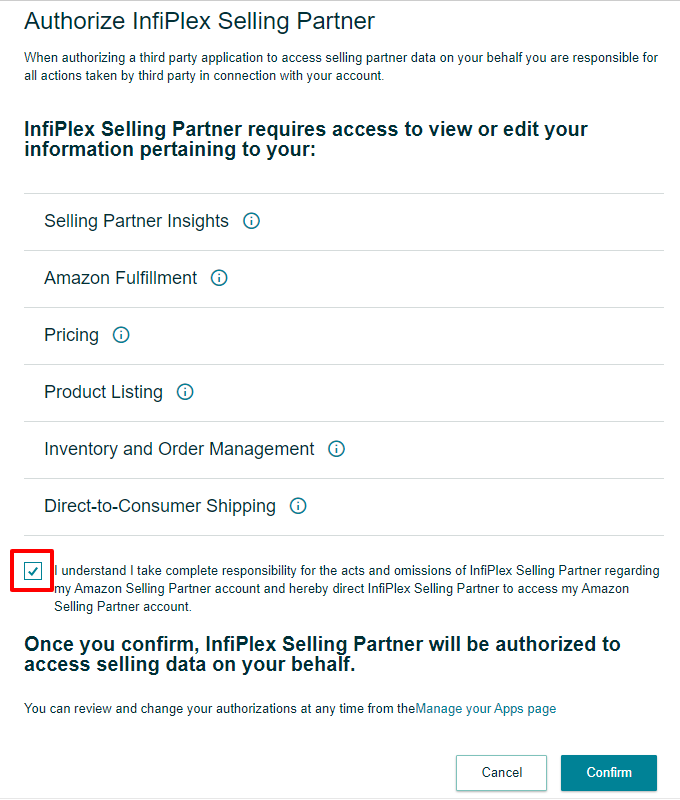
Sign up for a monthly package, and within 1–2 business days your InfiPlex OMS is set up and ready to connect to your Amazon account. From there it’s one authorization — approving the InfiPlex application from your Amazon account — and you have access to your Seller order data and order process through the web interface or the API connection.
No — that entire checklist belongs to the build-your-own path. Connecting through InfiPlex means authorizing an application that has already cleared registration, IAM configuration, RDT implementation, and Amazon’s review. You approve it from your normal Amazon account on the authorization page, and the developer-side obligations stay on InfiPlex’s ledger permanently.
The InfiPlex SP-API app is approved, Partner Network–listed, and live for your account in 1–2 business days — JSON through the API, or no code at all in the OMS.
Bring it. Contact us, email info@infiplex.com, or call 888‑770‑0857 and we’ll map your old MWS calls to what the InfiPlex API gives you — and get orders flowing while the rewrite question answers itself.
InfiPlex™ is a trademark of InfiPlex. Amazon, Amazon MWS, Selling Partner API, AWS, FBA, and all other marketplace and product names are trademarks of their respective owners and are used for identification purposes only; no endorsement is implied.
Our website uses cookies to help provide the best user experience. By continuing to use this site, you consent to the use of cookies as described in our Privacy Policy. OK